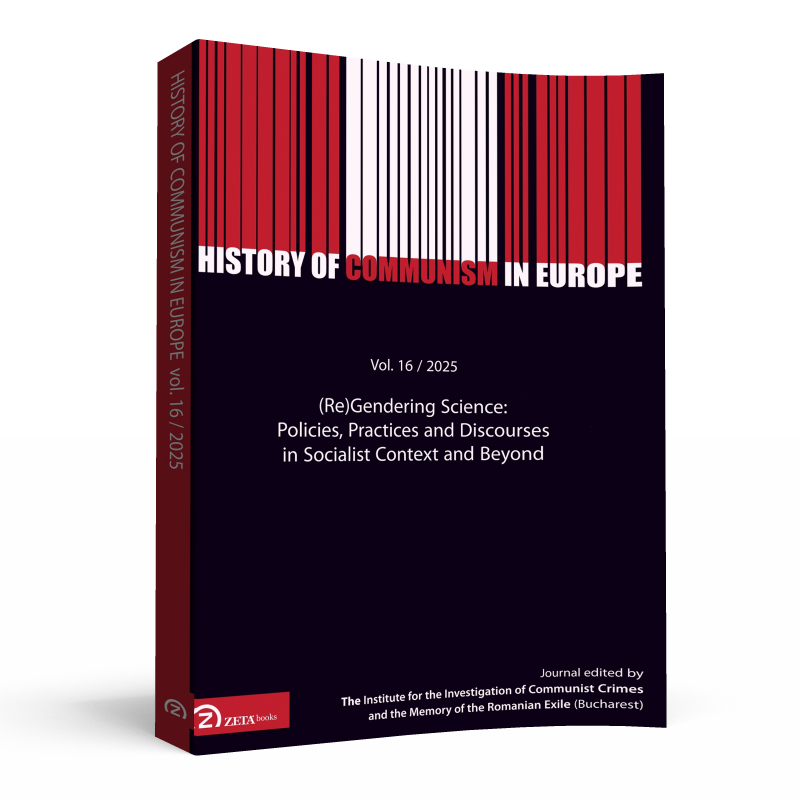
History of Communism in Europe, vol. 16 / 2025: (Re)Gendering Science: Policies, Practices and Discourses in Socialist Context and Beyond
TABLE OF CONTENTS
IRINA NASTASĂ-MATEI, LUCIANA JINGA, Introduction: The Gender of Socialist Science. Knowledge, Labor, and Representation in Eastern Europe and the USSR [OPEN ACCESS]
I. Institutions, Policies, and Structural Frameworks
DARRYL B. HILL, Uncovering Archival Traces and Explaining the Erased Cohort of Women Researchers who Completed Dissertations with Ivan P. Pavlov
Abstract: A cohort of 22 women medical students completed their doctoral research under the supervision of Russia’s famous physiologist Ivan P. Pavlov in the late 1800s and early to mid-1900s. This study uncovers traces of these worthy women’s lives and science, exploring explanations for their erasure from history. By examining various online English- and Russian-language databases and archival historical sources such as employment records, this paper contends that this cohort of women benefited from wartime labour shortages and likely profited from gender quotas. In Pavlov’s lab, the cohort benefited from Pavlov’s support for women’s education, becoming a majority of researchers and leaders, fulfilling Soviet communist quotas for the equal participation of women in work. Archival traces of their lives suggest that several of the cohort became notable within Russian and Soviet science, medicine, and literature. Yet there is little representation of this cohort in contemporary histories online. This paper considers explanations such as political ideology and gender-based plagiarism for this erasure, but instead suggests that androcentrism in science and medicine, negative beliefs about women’s wartime labour, and waning interest in Pavlov’s science contributed to the erasure of this remarkable cohort of early female Russian and Soviet scientists.
MARIUS DEACONU, Unintended Consequences: The Impact of Socialist Education Policies on Women’s Access to Higher Education in the 1980s
Abstract: In a manner consistent with other Eastern European countries, Romania officially promoted the principles of egalitarianism and the right to education. In practice, however, those policies had unexpected consequences, particularly for women seeking to enter higher education in the 1980s. This study explores how state reforms, demographic pressures, gender norms and structural changes intersected to influence women’s educational path during this period. Following the 1978 Education Act, first-year study places limitations to traditionally female-dominated subjects and the push for polytechnisation redirected many women towards technical subjects and male-dominated specialisations. Faced with intense competition and shrinking opportunities in ‘pink-collar’ fields such as teaching and healthcare, women adapted – often with remarkable determination – and, by the mid-1980s, they began to outnumber men in university enrolment. Using the concepts of the ‘triple burden’ and the emerging ‘quadruple burden’, this paper demonstrates how socialist reforms both reinforced gendered obstacles and opened new avenues for advancement. In late socialist Romania, women navigated a complex mix of progress and pressure, finding ways to thrive in a system that was never designed with them in mind.
ANNA HORSTMANN, Female Chemists and the Scientific and Technical Revolution: Promotion of Women in the Chemical Industry of the German Democratic Republic
Abstract: In the GDR, socialist planning authorities made targeted efforts to steer women towards scientific and technical professions. Using the chemical industry as a case study, this paper examines how these state efforts were put into practice at plants and combines. Through women’s advancement plans, female employees were to be motivated – albeit with varying intensity – to pursue chemistry degrees and assume leadership positions. The article investigates the challenges that arose in this process and assesses how effectively female chemists could actually be guided. Prominent issues included the dual burden on women from employment and household responsibilities, as well as gendered prejudices against female scientists and engineers.
II. Biographies, Personae, and Lived Strategies
CRISTIANA OGHINĂ-PAVIE, Alice Aronescu Săvulescu (1905–1970): Shaping a Scientific Identity between Gender and Political Boundaries
Abstract: Alice Săvulescu, née Aronescu (1905–1970), was a mycologist and plant pathologist. She earned her PhD from Columbia University in New York in 1934 and joined agronomic research in Bucharest later that year. Between 1946 and 1970, she held leadership positions in scientific institutions, published extensively, participated in international scholarly societies, and was elected to the Academy of the Popular Republic of Romania in 1963. This article examines Alice Aronescu Săvulescu’s biography through the lens of the scientific persona. It explores how her individual experiences, the specificities of plant pathology, and the social and political context shaped her scientific trajectory.
FANNI SVÉGEL, From Resistance to Recognition: Tekla Dömötör, Linda Dégh, and Hungarian Folkloristics under State Socialism
Abstract: This article traces the lives and careers of two prominent Hungarian women ethnographers, Tekla Dömötör and Linda Dégh, to explore the gendered dynamics of academic life in state socialist Hungary. Born into assimilated Jewish families around World War I, both navigated restrictive interwar educational norms, engaged in anti-fascist resistance during World War II, and pursued scholarly careers under socialist rule. Drawing on autobiographies, personal documents, and publications, the study examines how family responsibilities, domestic labour, and professional networks shaped visibility, recognition, and career trajectories. Dömötör combined resistance activities, teaching, and international research with raising two children, eventually becoming the first female head of the Folklore Department at Eötvös Loránd University. Dégh contributed to the reorganisation of Hungarian folkloristics before emigrating to the United States. By linking biography with broader institutional and political contexts, the article illuminates the intersections of gender, personal life, and scientific authority in socialist and transnational academic settings.
III. Book Review
Dalia BÁTHORY
Amelia Bonea and Irina Nastasă-Matei (Eds.). Negotiating in/ visibility. Women, science, engineering and medicine in the twentieth century (Manchester: Manchester University Press, 2025)
ISSN 2069-3192 (paperback)
ISSN 2069-3206 (electronic)